Tuesday, June 12, 2012
Seeing The Light
Genesis 1:3 declares the majestic creation of light, “And God said, ‘Let there be light.’ And there was light.” God spoke four words and billion of stars came into existence! My words seem so empty compared to that. And those four words continue to have an amazing impact on the universe!
We tend to think of creation as something that occurred in the past. But a series of discoveries that led to a phenomenon known as the Doppler Effect has produced evidence that it appears the universe is still expanding. In other words the studies of men like Christian Doppler, Richard Tolman, and Edwin Hubble indicate that "Let their be light" is an ever-present command that continues to shape the light-given bodies of our universe. God hasn’t stopped creating!
Physics is primarily a study of things you can't see. The laws of gravity and centrifugal force produce results that we can observe, but you can't see gravity or momentum. Physics is a science of the invisible: quarks, magnetic fields, and gravitational forces. And this week, we are going to explore the amazing creation of light and how it is relevant to our lives as Christians.
Arthur Zajonc wrote in his book Catching The Light: The Entwined History of Light and the Mind about about a fascinating experiment called Project Eureka. Zajonc and a friend carefully fabricated a box and positioned a powerful projector to shine light into the box. They designed the box so that it wouldn’t illuminate any objects in the box or the surfaces of the box. So within the box was pure light. However, when they looked inside the box, they didn't see pure light. They saw absolute darkness! You see, light is invisible! It is ironic that the thing that enables us to see can not be seen.
I mean think the pictures you have seen of space above the earth's atmosphere. Even though the sun shines all through "space", you cannot see any light. The sun’s light is everywhere, but it can only be seen when it is illuminating something.
What we see is reflected light. When white light hits a blue object, all the colors are absorbed by the object except blue. The blue is reflected back to your eyes. White objects reflect all of the light. Black objects absorb all of the light.
It is a difficult concept to imagine and explain, but light is always present yet it is always illusive! It is invisible, yet it illuminates everything. We can’t see it but you cannot see anything without it!
Does it remind you of anything? Let me give you a hint: "Now faith is being sure of what we hope for(A) and certain of what we do not see." Tomorrow, we will be looking at the Light of God, and our responsibility to reflect His light to the world.
Monday, June 11, 2012
Seeing The Unseen
“A mind stretched by a new idea never returns to its original shape.” - Oliver Wendell Holmes.
Our current sermon series is entitled The Physics of Faith. My hope is that our minds will be stretched to explore the amazing awesomeness of God!
Hebrews 11:3 says, “By faith we understand that the universe was formed at God’s command.” It takes faith to believe in the God of Intelligent Design who created the universe. You can’t prove or disprove scientifically the creation story of the Bible. However, it also takes faith to believe in the God of random chance, Big Bang, and evolution. In fact, I think it takes more faith.
Sir Fred Hoyle, an astronomer, made this statement to the British Academy of Science years ago, “Let’s be scientifically honest. The probability of life arising to greater and greater complexity by chance through evolution is the same probability as having a tornado tear through a junkyard and form a Boeing 747 jetliner.” Hoyle calculated the chances of life being the result of random chance as being 1 in 10 raised to the 40,000th.
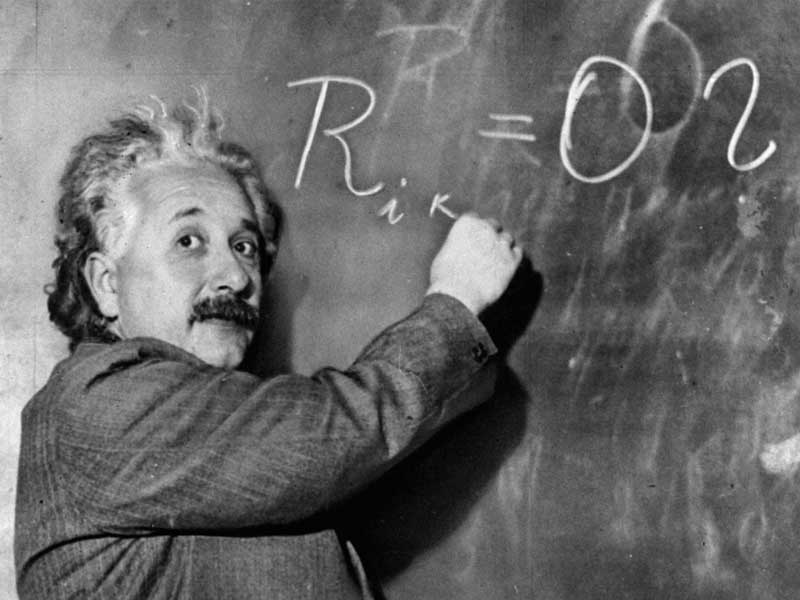
Albert Einstein said, “There are only two ways to live your life. One is as if nothing is a miracle. The other is as if everything is.”
I mean, take this example. Right now you feel as though you are not moving at all. However, as you are reading this, the planet is spinning at approximately 1,000 mph, making a complete revolution in 24 hours. Not only that, we are traveling through space, in our annual journey around the sun, at approximately 67,000 mph. You will travel 1.3 million miles today!
When was the last time you thanked God for keeping us in orbit? Most of us take constants for granted! Few of us get to the end of the day and say, “God, thanks for helping us make the full rotation today!”
Here is the problem with God for most of us...He is so good at what he does that we take Him for granted. He is so faithful, powerful, loving, and wise. And He is completely constant in these qualities. James 1:17 declares that God "...does not change like shifting shadows." He is the ultimate constant. But we tend to take constants for granted.
Here’s what we are going to explore this week: Our lives are utterly dependent upon things we can’t see and don’t understand. We are surrounded by miracles. We just take them for granted. We are going to focus on one of those miracles that I think is most amazing, yet primarily taken for granted.
Wednesday, June 6, 2012
The Blessings of Uncertainty
The Uncertainty Principle is a law of life. Uncertainty never goes away. You may get a brief rest from it, but eventually it returns. Life will always be filled with infinite uncertainties! There will always be unanswered questions and unexplained experiences.
Donald Miller writes this in Blue Like Jazz: “There are things you cannot understand, and you must learn to live with this. Not only must you learn to live with this, you must learn to enjoy this.”
We all eventually have to accept the fact that God is God and we’re not. Which means, there will be questions that will never be answered. There will experiences that will never be explained. The secret to success in life is to learn to embrace the uncertainty.
Hebrews 11:8 says, “By faith Abraham, when called to go to a place he would later receive as an inheritance, obeyed and went, even though he did not know where he was going.” Don't miss the phrase “even though he did not know where he was going”. That is scary isn't it. Sometimes I will have no idea where God is taking me. However it is also encouraging. If someone as loved by God as Abraham didn't have a clue, then maybe I’m okay. Because a lot of the time, I am clueless. I have my plans, my goals, and my dreams, but the truth is, most of the time, I have no idea where God is taking me!
A teacher of the law said to Jesus in Luke 9: “I will follow you wherever you go.” Jesus responded: “Foxes have holes and birds of the air have nests, but the Son of Man has no place to lay his head.”
You see, when you follow Christ, you never know where you’re going to end up. Anything can happen. That is intimidating, but it is also exciting. It is an adventure. And adventures are...fun! The element of surprise breathes joy into life. Thank God for uncertainty and unpredictability!
Tuesday, June 5, 2012
Uncertainty and Complexity
In 1932, a German physicist named Werner Heisenberg introduced a discovery that pulled the rug out from under the scientific community and is considered one of the greatest shifts in scientific paradigms in the 20th century. Heisenberg basically discovered that we cannot know the precise position and momentum of a quantum particle at the same time. Without going into a lengthy explanation of the Law of Uncertainty, Heisenberg was basically saying: there will always be an element of uncertainty.
Now let's shift to mathematics. A French-American by the name of Benoit Mandelbrot introduced a new study of complex shapes. Known as fractal geometry, Mandelbrot stated that some shapes are infinitely complex. What he meant by infinite complexity it that any detail can be magnified to reveal even more detail to the nth degree. Fractals are really the theological equivalent of what is called the incomprehensibility of God. God is infinitely complex.
So here's the deal. Life is infinitely uncertain and God is infinitely complex. It is the only place to start a series on the Physics of Faith. It is a recognition of our finiteness. Life is full of infinite uncertainties and God is infinitely complex. We can hate that. Or we can learn to love it.
Most of us hate negative uncertainties, bad things that happen that we didn’t expect to happen. And we love positive uncertainties, good things that happen that we didn’t expect to happen. But you can’t have it both ways. I think high levels of uncertainty make the best lives!
Hebrews chapter eleven is filled with heroes of the faith. I think we would all have to admit that each of them had a high tolerance for uncertainty! Each of them dealt with things that they didn't have a clue where they would conclude. That is what faith is all about. It is not just embracing uncertainty. It is learning to love it.
To many of us want a God we can control like a puppeteer. We want a predictable God. But that would create an amazing boredom. As we shall see in a couple of days...predictability leads to boredom. We we know something is always going to happen, we are no longer amazed by it. God continually amazes us because He is infinitely more complex that we will ever imagine!
Monday, June 4, 2012
The Law of Uncertainty
Our new sermon series is entitled The Physics of Faith. It is based on a series of message shared by Mark Batterson from National Community Church in Washington, D.C. In this series, I am going to challenge you to explore some immutable laws of physics that will help us better understand the God whom we worship.
By having two eyes instead of one, we are given an amazing optical capability called depth perception. If you cover one eye, everything seems flat. The reason is simple: you lose the ability to judge distances.
Unfortunately, sometimes many Christians go through life with only one eye open when God has given us two. Of course, I am speaking figuratively. Just as God as given us two physical eyes, He has also given us two figurative eyes. They eye of intellect and the eye of faith. If you choose to close either of them, you are not getting a full picture of what God desires you to see.
When we compartmentalize our intellect from our faith, we often lose perception and perspective. Albert Einstein may have said it best. “Science without religion is lame and, conversely, religion without science is blind.” Some Christians focus entirely on the intellect, and they lose the ability to dream, to trust, to believe in things that seem impossible. Other Christians, focus entirely on faith, and they live their lives without a sense of realism.
But what I hope to do in this series is to help us understand that learning and worshipping are not mutually exclusive endeavors. In fact, they are proportional: the more you know the better you can worship.
John 4:22 contains a fascination exchange between Jesus an a woman we refer to as the Samaritan woman. Jesus said to her, “You Samaritans worship what you do not know; we worship what we do know.” Read the New Living Translation of that verse and let me underscore a couple of words. “You Samaritans know very little about the one you worship.” Do you see it? Jesus links knowledge and worship together. Intellect and spirituality are not mutually exclusive terms.
When an astronomer looks into the night sky, he has a greater appreciation for the constellations and stars and planets because they see more than I do. When a musician listens to music they have a greater appreciation because they hear more than I do.
Even in the Great Commandment to love God, one quarter of the mind deals with the intellect. Mark 12:30, “Love the Lord your God with all of your heart and all of your soul and all of your mind and all of your strength.” Loving God with your mind is one-fourth of the command.
This series is being based on the passage of Scripture found in Romans 1:20, which says, “Since the creation of the world God’s invisible qualities—his eternal power and divine nature—have been clearly seen, being understood from what has been made.” Can you see the connection? We grow to understand God's invisible qualities like his eternal power and his divine nature, when we understand His creation. We are able to more fully worship God for who He is when we more fully understand what He has created.
As Batterson asks, "Can you imagine studying about an artist like Pablo Picasso without looking at his paintings? Can you imagine studying about a composer like Ludwig Von Beethoven without listening to his music? It seems absurd doesn’t it? It’s about as absurd as studying about the Creator without studying creation."
Subscribe to:
Comments (Atom)