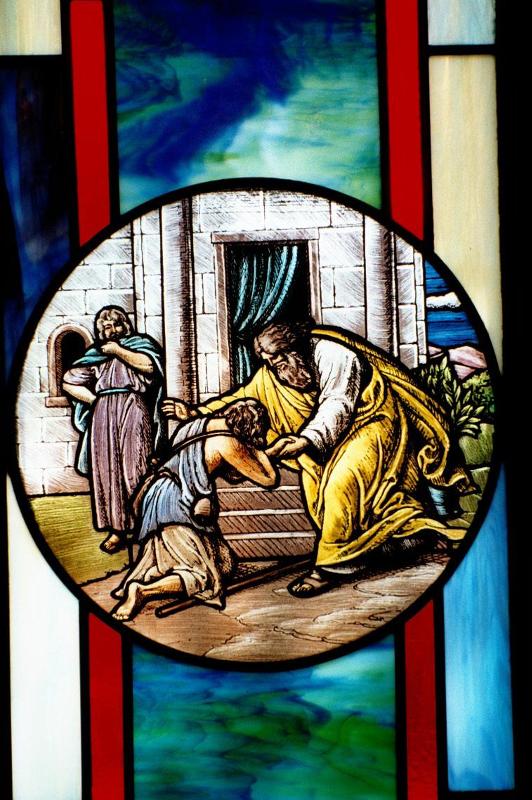
Sunday, May 6, 2012

The True Elder Brother


At 1.25 pm on the 28th of April, 1988 a Boeing 737 jet, Flight 243, operated by Aloha Airlines took off from Hilo International Airport in Hawaii. The plane had undertaken a remarkable 89,090 take offs and landings. This was its 89,091 take-off.

The plane was carrying 90 passengers and 5 crew and quickly climbed to an altitude of 24,000 feet. 23 minutes after take- off there was an explosive noise in the roof of the fuselage which lead to a catastrophic explosion and decompression of the cabin that ripped away much of the roof in the front section of the plane. Miraculously and with great skill the pilots of the plane were able to land plane 10 minutes later in Maui. 65 passengers were injured and one flight attendant lost her life.

The picture with this blog was taken shortly after the plan landed. Air crash investigators immediately began their work. The cause of the catastrophic explosion was traced to metal fatigue caused by corrosion. There was a failure of the adhesive used to seal joins in the aluminum sheets of the fuselage that allowed water to seep in.

One small crack. One small crack in a plane that no one could see lead to a catastrophic failure. Everything looked good on the outside. There was no reason to doubt the plane’s air worthiness; it all looked good.

Jesus told a story of a Father and two sons. The ‘bad son’ – the younger son – rebels against his father and squanders a third of the family fortune on wild living in a far country. All the while his older brother stays home, faithfully sticking by dad and working hard. He is the good son. But after his younger brother returns, and after his Father welcomes him back with open arms into the family – the cracks that were always there start to appear and a catastrophic explosion eventuates.

In our study this week we are going to explore an often missed twist that Jesus tells in the story. The drill-down point of this story is this: "Reconciliation and salvation always costs someone something." As we will see this week, salvation really isn't free...it was very costly to the true older brother.

Wednesday, May 2, 2012

Appreciating God's Grace

How do we keep from giving in to the rebellion of the Prodigal or the self-righteousness of the Older Brother. Let me close this week's study by giving you two suggestions.

First, remember the uniqueness of the Gospel message. It is a resignation of our own attempts to find fulfillment in the far country or in our obedient behavior. Either attempt will leave us empty and lost. The uniqueness of grace is that we can never find our God-ordained destiny through either journey. The world will leave us empty. Self-righteousness will leave us deceived. Neither leads to fulfillment. Only the grace of  God can lead us to our destiny.

Secondly, remember the vulnerability of Jesus. Verses 1, 2 of Luke 15 tells us that the whole reason this story is told is because of the muttering of the Pharisees over Jesus having fellowship with people they considered to be unacceptable. They are Jesus' mortal enemies. They are out to, and eventually will, crucify Him. Yet, when Jesus tells of the Father going out to plead with the older brother to come in and celebrate, He is showing His remarkable love for even the Pharisees. For in essence, He is telling them, "I am here to plead with you...come in and enjoy the Father's celebration!" Even though they want to kill Him, He is reaching out in love to them.


This love toward His enemies made Him vulnerable and cost Him his life. On the cross, instead of cursing His enemies, He lovingly took the penalty of their sins on Himself.  Knowing what He has done for us will rid us of our self-righteousness. We were so sinful He had to die for us. But we were so loved that He was glad to die for us. That takes away both the pride and the fear that makes us elder brothers.

Tuesday, May 1, 2012

Signs of an Older-Brother Spirit

The older brother reveals his heart when he speaks after the Father welcomes the Prodigal home. In Luke 15:29-30, Jesus tells us that the older brother said, “But he answered his father, ‘Look! All these years I’ve been slaving for you and never disobeyed your orders. Yet you never gave me even a young goat so I could celebrate with my friends. But when this son of yours who has squandered your property with prostitutes comes home, you kill the fattened calf for him!” This passage reveals five things about an older-brother spirit.

But before we look at them, let me give you a warning. For those of us who try to follow Christ faithfully. It is easy to slip into the older-brother mindset. In fact, it is our default mode. When we begin to lose our passion for the Father, and begin to become more passionate about the Father's things, one or all of those five attitudes will surface.
  1. A deep anger. Verse 28 says that "he became angry". Elder brothers believe their faithfulness should manipulate God's hand into giving His blessings to them. And if it doesn’t happen, they get angry.  
  2. A joyless and mechanical obedience.  Verse 29 reveals the heart of the older brother when he said to the Father, “I’ve been slaving for you.” Older brothers find obedience a joyless, mechanical, slavery.
  3. A coldness to younger brother-types. In verse 30, the older son does not even “own” his brother. He refers to him as "this son of yours". Christians who pride themselves on their doctrinal and moral purity, often feel superiority to those who have different views.
  4. A lack of assurance of the father’s love. He doubted the Father's love when he said in verse 29, "You never killed a fatted calf for me!" Every time something goes wrong for older brothers, they wonder if it’s a punishment. They often wonder if they've repented deeply enough. prayers asking for things, but not sense his love.
  5. An unforgiving, judgmental spirit. It is impossible to forgive someone if you feel as though you are beyond doing that vile of a sin. The older brother thought he would never be like the Prodigal, but the irony was, he was guilty of the same rebelliousness and motivated but the same sinful desires.

A Broader Perspective of Lostness

In Luke 15:28, Jesus said: “The older brother became angry and refused to go in. So his father went out and pleaded with him.” Surely the older brother knew that this was one of the best day's that his Father had experienced in years. The son who had been lost had come home. The older brother had to know this was a day of celebration.

Yet he refused to go into the biggest feast his father has ever put on. His refusal was a deliberate act of disrespect. In actuality, His attitude is no different that that of the prodigal when he left home. He is says, “I won’t be part of this family. I refuse to respect your headship of it.”

When we refuse to participate in the Father's celebration; when we refuse to participate in honoring the Father's headship, when we refuse to participate in worship of the Father, we demonstrate the same righteous lostness as the older brother.

The father, according to Jesus, had to “go out” to plead with him. Just as he went out to bring his alienated younger son into the family, he is now going out to try to bring the older brother into the house.

Jesus is expanding the religious concept of lostness. He is letting us know that the older son is lost as the younger son had been. In the end, the Prodigal, comes home and is saved. But the older son, refuses to go in. In fact, there is no record that he ever went in. He remained lost.

What is it that is keeping the elder brother out? Verse 29 tells us it’s because: “All these years I’ve been slaving for you and never disobeyed....” There is a telling phrase in this verse...I've been slaving for you. The rule-keeping son didn't serve the Father faithfully during the absence of the Prodigal out of loving obedience to His Father. He considered it slavery!

The younger brother wanted the father’s things, but not the father. So he left home. He broke the moral rules. But the older brother also wanted the same control of his Father's possessions. While the Prodigal got control by taking his stuff and running away; the elder brother got control by staying home and being very good. He felt that now he has the right to tell the father what to do with his possessions because he had obeyed him perfectly.

There are two ways to be your own Savior and Lord. One is by breaking all the laws and being bad. One is by keeping all the laws and being good. If I can be so good that God has to answer my prayer and give me His things, I reduce Jesus to being my Rewarder. But I don't just need a Rewarder. I need a Savior.

The difference between religion and Christianity is that the religion obeys to get control over God, and things from God, but the Christianity obeys just to love and please and draw closer to God.

Sunday, April 29, 2012

The Elder Brother

One of the things that many people don't know about my wife is that she loves to laugh. She enjoys a good joke, a funny story, and just being around people that make her laugh. One of her favorites things to do is to hind around the corners of our house and when you least expect, jump out from behind the corner and scare you. She things it is hilarious.

And I get so irritated, the only response I can give is "That's not funny". When we were younger, I used to be really worried that on one of her "Surprise!" moments, I would be so caught of guard that I would actually hit her. It never happened, but I was afraid it might.

Surprises are a part of regular living. Some surprises are good; other's not so good. In the Parable of the Prodigal Son found in Luke 15, Jesus is going to lay a surprise on the Pharisees that totally shocked them.

Most people who read and study the parable of the concentrate completely on the character of the younger son, his repentance, and the father’s forgiveness. And yet when you look at the text, it doesn’t end with the return of the prodigal. Almost half of the story is about the older son. 

The story is about two sons, who are both alienated from the father, who are both assaulting the unity of the family. Jesus wants us to compare and contrast them. The younger son is “lost”, that is easy to see. We see him shaming his father, ruining his family, sleeping with prostitutes, and we say, “yes, there’s someone who is spiritually lost.”

But Jesus’ point is that the older son is lost too. This week, we are going to discover a startling new understanding of elder-brother lostness, what the signs of it are, and what we can do about this condition.