Wednesday, May 30, 2012

God's Provision


In Psalm 34:18, the Psalmist reminds us: “The LORD is close to the broken-hearted and saves those who are crushed in spirit.”

Moses poured out his heart to God in a strong lament? He had grown weary from the burden of leading God’s grumbling people. Moses voiced his complaint to God about God. And how did God respond? Did God give up on Moses? Did God walk away from Moses? Numbers 11:16-17 says: “The LORD said to Moses: “Bring me seventy of Israel’s elders who are known to you as leaders and officials among the people. Have them come to the tent of meeting, that they may stand there with you. I will come down and speak with you there, and I will take some of the power of the Spirit that is on you and put it on them. They will share the burden of the people with you so that you will not have to carry it alone.”

God gave Moses a plan to help him with his burden. Amazingly, God poured out His Spirit on some of the very same people who had been complaining about Moses. They very one causing Moses burden would be used to bring Moses relief!

God’s care for desperate people is consistent with his merciful and gracious character. "The Lord is close to the brokenhearted and save those who are crushed in spirit." God had told Moses in Exodus 3:7: “I have indeed seen the misery of my people in Egypt. I have heard them crying our because of their slave drivers, and I am concerned about their suffering.”


God is saying: “I see, I hear, I am concerned.” Sometimes we wonder if God really cares. Does God really hear our cry of despair? Moses thought the answer to those to questions were, NO! This was Moses complaint in Numbers 11:21-22: “But Moses said, “Here I am among six hundred thousand men on foot, and you say, ‘I will give them meat to eat for a whole month!’ Would they have enough if flocks and herds were slaughtered for them? Would they have enough if all the fish in the sea were caught for them?”


There were millions of them in desert, and God said He provide a month’s supply of meat. And God response to Moses ought to be a powerful reminder to us. The Lord answered Moses in verse 23:, “Is the LORD’s arm too short? Now you will see whether or not what I say will come true for you.”


When we are in trouble, it is easy to give in to despair. Our situation may seem hopeless and it may seem as though God has deserted us and is uncaring. But remember...God sees. God cares. God provides.

God asked Moses, and he asks us, "Is my arm to short to provide for you?’ There is only one right answer. "The Lord is close to the broken-hearted and saves the crushed in spirit." Our desert and barren situations are fertile ground to experience God’s miraculous provision.

Tuesday, May 29, 2012

The Land Between Part 2


Last week, I  introduce the idea of the Land Between. It is not an original idea, but I got it from the book entitled, The Land Between: Finding God In Difficult Transitions, by Jeff Manion.

For more than two hundred years the people of Israel had lived in Egypt along the fertile crescent area of the Nile River, which was a very fertile land. Egypt, at this time, was a unilateral world power. Eventually Israel grew and prospered so much that they became a threat to the Egyptians. Under a tyranical Pharaoh, they were subjected to a terrible form of slavery. Over the course of time, the Israelites cried out for deliverance and their cry was heard by the God they barely knew or remembered. God then made this promise in Exodus 3:8: “(I will) bring them up out of that land and into a good and spacious land, a land flowing with milk and honey.”

And God fulfilled his promise. Through a series of miraculous events, the plagues, the parting of the Red Sea, water from a rock in the desert, and a host of other miracles, God led Israel OUT OF Egypt and forty years later INTO the Promised Land.

Between the out of and into is the place that Manion calls The Land Between. For Israel, the Land Between is a desert place. It is the Sinai Peninsula. It is a difficult place. It is where faith either grows or dies. It is in the Land Between that perhaps the most important, and certainly the biggest, part of the Exodus story is found.

Life is a passage between the past which has shaped us and the future we hope to construct and possess. Between the certainty of the past and the uncertainty of the future is the Land Between. It is a place of uncertainty, disruption and questioning. While there, we may experience heartache, pain, and struggles. But although it may be a spiritually dry place, it can also be fertile place where faith grows and flourishes.

Last week, we looked at the difference between the people's murmuring and Moses' lamenting. This week we are going to see three different things God did while they were in the Land Between: He provided; He disciplined; and He helped them grow!

Thursday, May 24, 2012

Great Is Thy Faithfulness


If ever there were a champion lamenter, Jeremiah would have to be it. His life as a prophet was tough. His message wasn’t popular. Jeremiah went 23 years without one convert (Jeremiah 25:3). Think those numbers would look good on a report? There is a book in the Bible that is full of Jeremiah’s laments to the Lord. It is called Lamentations. Throughout this book, Jeremiah complains to God about how know one will accept or even appreciate his ministry. If you are depressed, Lamentations is not the book in the Bible to read. It is miserable from beginning to end – almost. Right in the middle of Lamentations, sandwiched between Jeremiah’s grief and sorrow, are these words from Lamentations 3:19-24: "I remember my affliction and my wandering, the bitterness and the gall. I well remember them, and my soul is downcast within me. Yet this I call to mind and therefore I have hope: Because of the LORD’s great love we are not consumed, for his compassions never fail. They are new every morning; great is your faithfulness. I say to myself, “The LORD is my portion; therefore I will wait for him.


Right in the middle of his Land Between, in the depths of his despair, Jeremiah is able to testify that God has not abandoned him.

Jeremiah understood that in lament, in the very act of voicing our trouble to God, we begin a conversation in which we have opened ourselves up to His care, mercy and provision.

Now's here's the really interesting thing about Moses' lamentation. Remember how Moses poured out his heart to God? The burden of leading God’s grumbling people was too heavy for him. So Moses complained to the Lord about his situation (Numbers 11:11-15)

What happened after Moses complained to God about his situation? Did God give up on Moses? Did God walk away? Numbers 11:16-17 gives us God's response to Moses' complaints: "The LORD said to Moses: “Bring me seventy of Israel’s elders who are known to you as leaders and officials among the people. Have them come to the tent of meeting, that they may stand there with you. I will come down and speak with you there, and I will take some of the power of the Spirit that is on you and put it on them. They will share the burden of the people with you so that you will not have to carry it alone."

God was so gracious to Moses that He poured out his Spirit on some of the very same people who had been complaining about him, not to him. The steadfast love of the Lord never ceases. Not only did Moses' lamentation bring relief to him, but it became a blessing to the very people Moses was lamenting about!

What an amazing illustration of how God's mercies never come to an end. They are new every morning. Great is His faithfulness.

Wednesday, May 23, 2012

We Have Lost Our Appetite


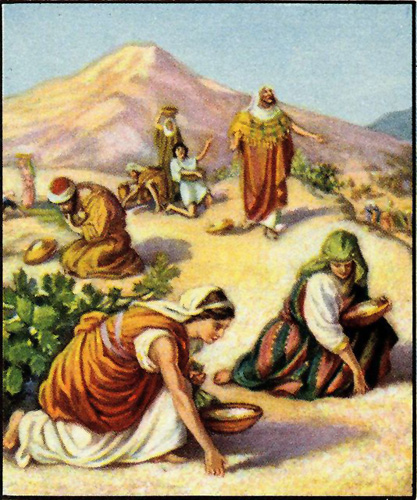
Numbers 11:4-6 says, "If only we had meat to eat! We remember the fish we ate in Egypt at no cost – also the cucumbers, melons, leeks, onions and garlic. But now we have lost our appetite; we never see anything but this manna!”

Don't miss that small little phrase that begins the third sentence of this passage..."We have lost our appetite". Why? "We never see anything but this manna!"

Having traveled through the wilderness for many, many days, the people of Israel fall prey to a common problem...selective memory. They begin to remember their days in Egypt. They remembered having meat to eat, free fried fish, and all the salad and fruit you could want. They remembered never having to worry about the variety of their meals.

But they forgot two very important things. First of all, they really didn't get "the fish we ate in Egypt at no cost...." It really came at a great cost...their freedom. They forgot their bondage. They forgot the hours of making bricks and laboring to build the massive Egyptian structures. They forgot the beatings and the executions. All they can remember is the food.

Like Israel, we tend to remember only the pleasant things, the good things. That why we fondly reminince about the good old days. Don't get me wrong. There were some good things in those days. But there was plenty that wasn't so good either. It is just our nature to remember the good over the bad. 

Secondly, they forgot that the very thing they are complaining about now, manna, was a free gift from God that, at one time, they were very grateful to receive it. It wasn't that manna was bad. It was just they had grown use to it. They received it everyday. If it were taken away, they would surely miss it, they were taking it for granted now, rather than seeing its blessing.

Isn't that how we treat God's grace. We all know that we would miss it if it wasn't there, don't we? We all know that we are dependent on it to survive spiritually. But because it is so freely given, because by its very definition, grace is, well, grace, we sometimes take it for granted that it is there.

The danger? As Israel demonstrates, when we take something freely given for granted, we tend to lose our appetite for it. When we have experienced a blessing for so long, we tend to feel like we're missing out on something else. "We never see anything but..." 

Isn't it true that what followed that but, "this manna", was more than enough. Isn't it true that manna in freedom, even in a wilderness, is better than meat in slavery?

But do we really believe that? Do we ever find that we have "lost our appetite" for God? Do we ever secretly wonder if there is something better that what we are always seeing?

As for me, manna in the desert beats meat in slavery anytime!

Tuesday, May 22, 2012

Murmur or Lament?


No sooner had the Israelites left slavery and bondage of Egypt, they began to complain. They complained about the lack of water. They complained about a lack of food. Then they complained about the lack of variety of food. Numbers 11:4-6 says, "If only we had meat to eat! We remember the fish we ate in Egypt at no cost – also the cucumbers, melons, leeks, onions and garlic. But now we have lost our appetite; we never see anything but this manna!” They complained about Moses and to Moses. They complained about the God they barely knew. In the Land Between, the Israelites became champion complainers.

Tomorrow, we are going to focus on the phrase "We have lost our appetite". Today, I want to drill down on the difference between murmuring and lamenting. The first puts us on dangerous footing with God; the second actually brings us face to face to God.

In the Land Between, the Israelites whined and complained to one another about how God had let them down. They gave in to discouragement. They did not complain to God. They complained about God.  And there is a big difference. The Bible calls murmuring. Murmuring is complaining about a situation to someone other than the person to whom you are murmuring. The New Testament word for this is gossip. And God rebukes the Israelites for their murmuring.

And the reality is, murmuring does no good! Usually the person we are murmuring to cannot do anything to change the situation. Our murmuring is usually just an attempt to divide and cause people to take our side!

By contrast, there is another form of complaint in the Bible that God seems to affirm. It is called a lament. If murmuring is complaining about God, lament is faith-filled complaining to God.
 Murmuring is gossiping about God; lament is a prayer of desperation to God. Murmuring is a hopeless cry of despair. Lament is a despairing prayer of hope.

There is a wonderful example of a godly lament in Numbers 11:11-15. The Israelites were complaining about manna. And then we are told that God was angry about the Israelites murmuring. Moses was at the end of his rope also. Moses asked the Lord, “Why have you brought this trouble on your servant? What have I done to displease you that you put the burden of all these people on me? Did I conceive all these people? Did I give them birth? Why do you tell me to carry them in my arms, as a nurse carries an infant, to the land you promised on oath to their ancestors? Where can I get meat for all these people? They keep wailing to me, ‘Give us meat to eat!’ I cannot carry all these people by myself; the burden is too heavy for me. If this is how you are going to treat me, please go ahead and kill me—if I have found favor in your eyes—and do not let me face my own ruin.”

Sounds like Moses is complaining as well, doesn't it? The difference? In their murmuring the Israelites are complaining about God. In his lament Moses is praying to God. There is a huge distinction. Moses isn’t rejecting God. In bringing his questions and complaints, Moses has turned towards God, not away from him.