Sunday, April 29, 2012

The Elder Brother

One of the things that many people don't know about my wife is that she loves to laugh. She enjoys a good joke, a funny story, and just being around people that make her laugh. One of her favorites things to do is to hind around the corners of our house and when you least expect, jump out from behind the corner and scare you. She things it is hilarious.

And I get so irritated, the only response I can give is "That's not funny". When we were younger, I used to be really worried that on one of her "Surprise!" moments, I would be so caught of guard that I would actually hit her. It never happened, but I was afraid it might.

Surprises are a part of regular living. Some surprises are good; other's not so good. In the Parable of the Prodigal Son found in Luke 15, Jesus is going to lay a surprise on the Pharisees that totally shocked them.

Most people who read and study the parable of the concentrate completely on the character of the younger son, his repentance, and the father’s forgiveness. And yet when you look at the text, it doesn’t end with the return of the prodigal. Almost half of the story is about the older son. 

The story is about two sons, who are both alienated from the father, who are both assaulting the unity of the family. Jesus wants us to compare and contrast them. The younger son is “lost”, that is easy to see. We see him shaming his father, ruining his family, sleeping with prostitutes, and we say, “yes, there’s someone who is spiritually lost.”

But Jesus’ point is that the older son is lost too. This week, we are going to discover a startling new understanding of elder-brother lostness, what the signs of it are, and what we can do about this condition.

Wednesday, April 25, 2012

The Undeserved Favor of God


After the Prodigal Son comes to his senses he begins the long journey home. He starts to practice his excuses. He knows a lot depends on his choice of words. The key to his strategy is to earn his way back into community (like many people believe today), to pay back his debt bit by bit as a hired hand. It’s the best he can expect in what is a desperate situation.

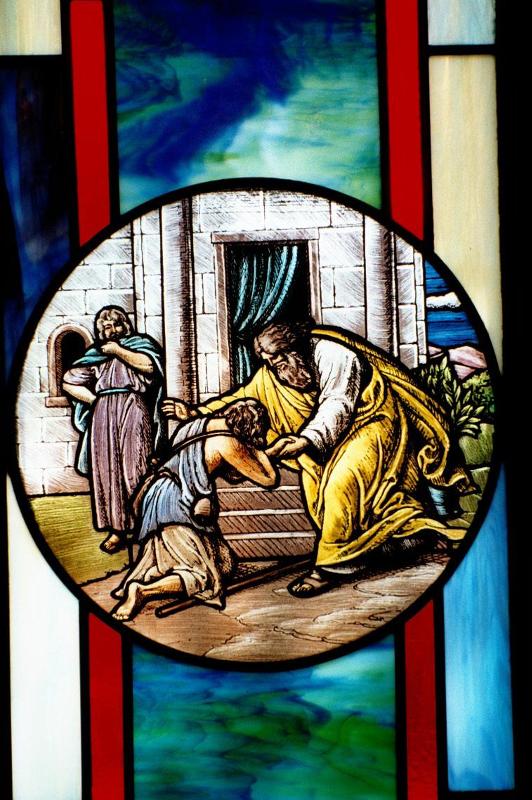
As he walked along the dusty road, his head downcast rehearsing his lines, he is astonished at a commotion ahead of him. Off in the distance, miles from home and coming towards him is the unmistakable figure of his Father running, not walking towards him. The son doesn’t know what to think. Before he can fall at his Father’s feet and beg for mercy, his dad is holding him up in a bear-hug, smothering him with kisses and showering him with tears of joy.

Stunned, the son pulls away and begins the lines he has memorized. This is the ticket home. Before he can finish the speech, the Father interrupts him, demanding that one of the servants clothe him with his best robe, place the family ring on his finger and kill the fatted calf for a celebration for the family and the whole village.

For his actions, the son deserves the Father’s rejection; instead he receives complete acceptance. Nothing in the rebellious son’s character merits mercy; instead the Father showers him with forgiveness. The son believes his only hope is to earn back the Father’s favor; instead he is smothered with a free gift of unconditional love.

As surely as the Father smothers his son with tears and kisses of joy, our Heavenly Father showers us with grace...underserved, unmerited and unearned favor. And in the Father’s love, just as the rebellious son is restored, fully and completely, to the family he had walked away from, we too can experience the wonderful restoration of God's love.

Here is the heart of the Christian gospel; long before we turn our face towards God in repentance, God is running towards us in loving embrace. The Apostle Paul famously said in Romans 5:8: “God demonstrates his own love for us in this: While we were still sinners, Christ died for us.” While we were running away from God, God was running towards us. While we turned our back towards God in open rebellion, God was turned towards us in loving embrace.

Tuesday, April 24, 2012

Coming To Our Senses


Eventually, in Jesus’ story about the Prodigal Son, He tells us that the younger son finds himself as far from his family as he can possibly be. In a foreign country, living among strangers, broke and destitute, the younger son suddenly sees through the fog of his own rebellion. He realizes what he has squandered; he recognizes that his only hope for survival is to throw himself at the feet of his Father, begging for mercy. And so he begins the long journey home, all the way rehearsing his speech.

The term the Bible uses for the younger son’s awakening is “he came to his senses.” When he came to his senses, he began to turn back towards his Father. Repentance begins when we come to our senses.

How do we come to our senses? Can I suggest there are two ways? The first is through conviction. The Bible tells us that God’s law is written on every human heart. We know what is right and what is wrong. We find elaborate ways to suppress that knowledge, but try as we might, every now and then our conscience pricks us and we know the path we have chosen is the wrong one.

The second way we come to our senses is through circumstances; more often than not painful circumstances. The younger son “came to his senses” when his money had run out, his belly was growling for food and he was covered in the shameful muck of a pig sty. His circumstances had uncovered and exposed his rebellion. Pain has a very happy knack of getting our attention.

You see sin always leads to pain. Romans 3:23 tells us that "the wages of sin is death..." Sin always takes you down paths you don't want to go. Sin always leads to places you don't want to be. When a pastor is warning you of sin, it is not that the pastor is a killjoy who doesn't want you to have any fun. When God warns of sin, it is because, as your Designer, your Creator, He knows what will harm you. It is not harshness or legalism which leads to the warnings of sin...it is grace! God in His grace is trying to warn you from to not go down roads that lead to painful circumstances.

The journey towards healing and wholeness begins when we come to our senses. The journey home to our heavenly Father’s open arms of love begins when we wake up to our rebellion.

The possibility of restoration, healing, forgiveness opens up as we begin to turn away from our sin and instead turn towards the loving arms of God.

Sunday, April 22, 2012

When God Ran

Last week, we began a journey into Jesus’ most famous story known commonly as the prodigal Son. It’s a story of two sons and a Father who loved them both. We began by looking at the context that Jesus told the story in, discovering that Jesus was directly responding to the accusation of religious people that he was a friend of the wrong people, people known as sinners, the rule-breakers. Jesus does not defend himself against the accusation. In fact he agrees with it! Not only is Jesus a friend of sinners, people supposedly lost to God are exactly the ones that are the focus of his life.

The story begins with the younger of two sons coming to his Father and asking for his share of the family estate. ""There was a man who had two sons. The younger one said to his father, 'Father, give me my share of the estate.'" Some cultural background at this point is really important. In Ancient Middle-Eastern culture it was customary for a patriarch’s estate to be divided on his death between his surviving sons. The oldest son was entitled to a double portion of what the other son’s received. So in a family of two sons the older brother would receive two-thirds of the estate and the younger brother one-third. The other rule, set in stone, is that the estate would only ever be divided when the Father died, and not before.

The opening shock of this story for Jesus’ audience would be this; effectively the younger son was saying to his father, “You are dead to me! I’m not waiting for you to draw your last breath, for your body to be buried deep. I want it all and I want it now!" This was a stunning, shame-filled slap in the face for the Father. His youngest son was by his actions saying to him I love what you can give me more that you. 

By his actions, the younger son was ripping apart his family. He was treating his Father as if he was dead and was walking away from his older brother. By forcing his Father into liquidating family assets, selling land and property, he was bringing down economic hardship. And all this would have been watched by the wider community, who would have been open-mouthed at the disrespect shown to the father. It was shameful. It was an incredible act of selfishness.

This week we are going to explore the motivation of the Prodigal's rebellion, the source of the turn-around in his life, and the grace that was shown to him by his father. Though each of us easily fall prey to the the Prodigal's real source of rebellion, the Good News is, our Father is always wanting to run to us to welcome us home!


Thursday, April 19, 2012

Redefining Sin

The parables of Luke 15 were birthed out of the Pharisees' mumbling among themselves that Jesus ate and fraternized with sinners. Jesus knew what the Pharisees were thinking. He could overhear their muttering. However, rather than slinking away and avoiding their accusations of questionable behavior, He confronted them with three stories about lost things being found. Actually, to be precise Jesus tells one story in three different ways. Verse 3 says “Then Jesus told them this parable...” There are three different scenes to describe the same story about lost thing. Today, we are going to focus in on how Jesus redefines sin.

For the Pharisees, sin was merely breaking the rules. But in these stories, Jesus redefines their paradigm to help us understand that sin is so much more complex.

In the first a shepherd with one hundred sheep loses one. He leaves the ninety nine to go on a search and rescue mission for the lost sheep. He returns from the wilderness with the sheep on his shoulders, and invites everyone to rejoice with him over the return of the one lost sheep.

In the second scene, an nameless woman loses one of her ten silver coins. She turns her house upside down, until she finds it. And when she does find it, joy overflows, and again, a celebration!

In the third scene a rebellious son turns his back on his Father, losing himself in the far country. Broke and destitute, he turns towards home to live as a servant rather than a son.  But before he can spill out his excuses, his father,  the one he rejected, runs to him in an open, joy-filled embrace. The lost son has come home. And again, a celebration!

Luke 15 is three scenes telling the same story of lost things being found. Why? The Pharisees had a 21st century view of what was sinful. To them, a sinful person was someone who broke the religious rules. Sinful people were the rule-breakers. And rule-breakers are lost to God.

But in these three scenes Jesus goes way beyond the Pharisees definition of sin. Sheep were known as foolish animals. So the people hearing Jesus when he spoke this parable would immediately assume the sheep was lost because of its foolishness. It did a dumb, sheep-like thing and was separated from the rest of the flock and the shepherd that protected it. It followed its appetite into lostness

A coin is in inanimate object, incapable of thought and certainly incapable in itself of finding its way home. The coin is lost through thoughtlessness of its owner.

And the prodigal son finds himself lost in a far country because of his own poor choices. The son is lost because of willfulness.

The lostness of these three objects were not just the result of breaking rules. In these three scenes Jesus is challenging the Pharisees simplistic view of sin...that sin is breaking religious rules. Jesus is saying that people find themselves lost, far from God, for a complex set of reasons.

Tim Keller gives a great example. "Mr. Smith has a problem with abusive anger, he often flies off the handle and is verbally abusive and sometimes physically so. Why? Is his problem genetic? Is it a matter of brain chemistry? Is it just part of his inborn nature, 
as in the example of the sheep?  Or is his problem the result of a bad environment? Perhaps the result of poor parenting and family life? Was he, like the coin, mismanaged by his 'supervisors'? Or does his problem stem from selfishness and pride, as with the prodigal son?"

The answer is that usually, in varying degrees, it is all of the above. The fact is, usually sin (mistakes and failures) occur in our lives for a mixture of complex reasons: our foolishness, other's thoughtlessness, and/or our willfulness. Keller continues: "Sin is deeply complex. It is inborn in you, it is magnified by sinful treatment, and is deepened and shaped by your own choices."

Perhaps we can find discover a greater depth of mercy for the sinner when we realize the complexity of his lostness.